WooCommerce vs Shopify for Sustainable Brands – Platform Comparison
Quick answer: Shopify usually suits vegan founders who want a fast, managed, lower maintenance store. WooCommerce is often better for brands that need deeper SEO, publishing, ownership, and customization control.
The best platform is not the one with the lowest advertised price or the longest feature list. It is the one your team can maintain while supporting product education, ethical claims, site performance, customer experience, and growth.
What Is the Difference Between WooCommerce and Shopify for Sustainable Brands?
Shopify is a hosted ecommerce platform, while WooCommerce is an open source ecommerce plugin that runs on WordPress and requires separate hosting.
- Shopify includes hosting, security, core updates, and much of the technical infrastructure.
- WooCommerce gives you more control over hosting, code, plugins, content, and site structure.
- Neither platform is automatically more sustainable. Impact depends on hosting, image sizes, scripts, theme quality, and business operations.
- Shopify generally suits founders who want simplicity. WooCommerce suits founders who want flexibility and control.
For a vegan food brand, the choice affects subscriptions, delivery information, allergen details, bundles, and stock management. For cruelty free cosmetics or ethical fashion, it may affect ingredient education, certifications, material disclosures, filtering, and long form content.
The right platform should match the way your business operates, not just the features listed on a sales page.
WooCommerce vs Shopify for Sustainable Brands, Compare the Factors That Affect Growth
Shopify offers more predictable bundled costs, while WooCommerce provides flexible costs that vary with hosting, extensions, and technical support.
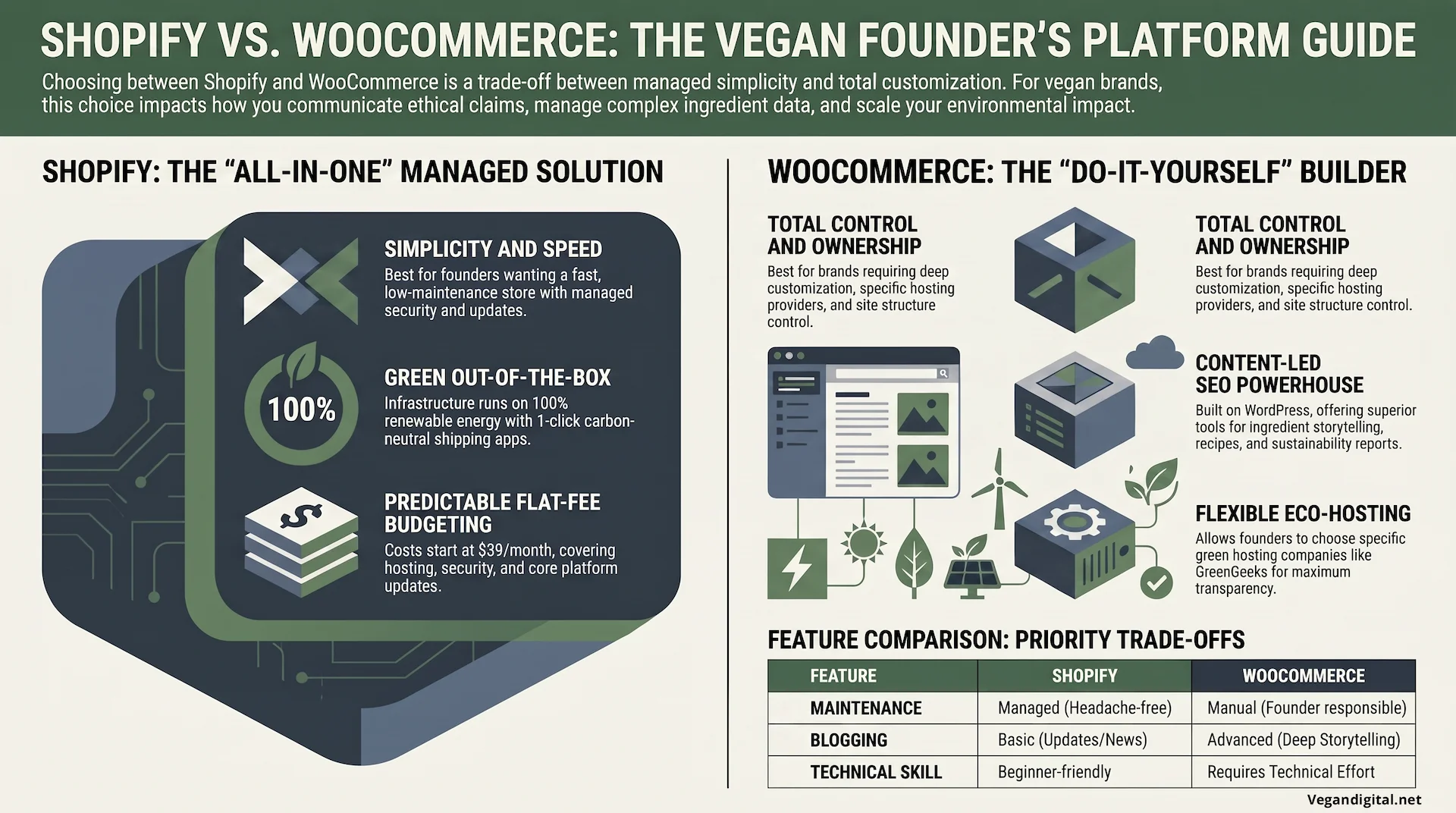
| Feature | Shopify (The “All-in-One” Package) | WooCommerce (The “Do-It-Yourself” Builder) |
| Eco-Friendly Web Hosting | Built-in. Shopify runs on servers powered by 100% renewable energy automatically. | Your choice. You have to find and pay for your own eco-friendly hosting company. |
| Sustainability Apps | Super easy. Has a great app store with 1-click tools to offer carbon-neutral shipping or plant trees at checkout. | Very flexible, but manual. Lots of green plugins exist, but they take a bit more technical setup to get working perfectly. |
| Blogging & Storytelling | Good enough. Covers the basics if you just want to post occasional updates or news. | The absolute best. Built on WordPress, so if educating customers through rich, deep articles is your main strategy, this wins. |
| Ease of Use | Beginner-friendly. They handle all the tech, security, and updates for you. You just focus on selling. | Takes effort. You are responsible for updating the site, keeping it secure, and fixing things if they break. |
| Cost | Predictable. You pay a flat monthly fee (starting at $39/mo) plus extra for premium apps. | Variable. The base tool is free, but you pay separately for your green hosting, design themes, and helper tools. |
| Who is it best for? | Founders who want a fast, easy, headache-free store that is green right out of the box. | Founders who want total control over their website and rely heavily on blogging to grow their audience. |
- Do not compare only a free WooCommerce installation with Shopify’s monthly plan. Include hosting, premium themes, plugins, apps, backups, security, development, and ongoing maintenance.
- Shopify is easier to budget for initially, but recurring apps and payment fees can raise the real cost.
- WooCommerce has no core platform fee, but technical problems become a business cost when updates damage checkout or site speed.
- Shopify is usually simpler during traffic spikes. WooCommerce can scale well with suitable hosting, caching, and monitoring.
A small vegan skincare brand with limited technical support may benefit from Shopify. A plant based food company with an established WordPress content hub may gain more from WooCommerce.
Check the Shopify Help Center and WooCommerce Documentation for current platform requirements and features.
Which Platform Has Better SEO for Ethical and Vegan Ecommerce?
WooCommerce generally offers deeper SEO control, while Shopify provides strong SEO basics with less technical maintenance.
- WooCommerce works within WordPress, which supports detailed content architecture, internal linking, and educational resources.
- Shopify supports important ecommerce SEO settings, including editable titles, descriptions, content, redirects, and mobile friendly storefronts.
- WooCommerce offers more control over URLs, templates, plugins, and server settings, but incorrect configuration can create technical problems.
- Neither platform guarantees rankings. Search intent, product quality, useful content, reviews, links, and conversion experience matter more.
WooCommerce may suit a brand publishing ingredient explainers, ethical sourcing pages, recipes, or sustainability reports. Shopify may be more practical when the team needs reliable SEO foundations without managing plugin conflicts and server settings.
Use Google Search Console to monitor clicks, impressions, indexing, and queries. Test important templates with Google PageSpeed Insights, especially pages with large images, reviews, recommendation tools, and tracking scripts.
For product structured data, follow the Schema.org Product guidelines and test the result with the Google Rich Results Test.
The Sustainability Test, Which Platform Better Supports a Low Impact Brand Experience?
Shopify is not inherently more sustainable than WooCommerce. A lightweight, well maintained store on either platform can be the better choice.
- Shopify’s managed infrastructure can reduce technical workload. WooCommerce gives you more control over hosting, caching, image delivery, and scripts.
- Apps and plugins can support subscriptions, donations, carbon information, product education, and local delivery.
- Too many add ons increase costs, maintenance work, security risks, and page weight.
- Use evidence for claims about materials, ingredients, packaging, sourcing, and certifications. Avoid vague claims such as “100 percent eco friendly” without proof.
What People Miss
Platform choice is only one part of digital impact. A heavy theme, oversized photography, excessive tracking tools, and poorly selected apps can slow a store on either platform.
Operational constraints matter too. A food business may need accurate inventory and delivery rules more than advanced design freedom. A cosmetics business may need careful ingredient data and compliance checks. An ethical fashion brand may need detailed size, supplier, repair, and returns information.
What This Can Fix and What It Cannot Fix
Choosing the right platform can reduce maintenance friction, improve content structure, support better product organization, and provide more suitable integration options.
It cannot fix unclear positioning, unreliable suppliers, unsupported sustainability claims, weak photography, slow fulfilment, poor customer service, or a product that does not meet market demand.
Use PageSpeed Insights to find performance issues. The UN Sustainable Development Goals and B Corp certification overview can provide useful context for wider sustainability work, but neither resource certifies an ecommerce platform.
Shopify or WooCommerce, Match the Platform to Your Founder Profile
Shopify is usually best for founders who value speed and simplicity. WooCommerce is usually best for founders who value ownership and customization.
- Choose Shopify if your team has limited technical capacity, needs to launch quickly, or wants managed security and infrastructure.
- Choose WooCommerce if you already use WordPress, need a substantial content hub, or require custom functionality.
- WooCommerce is a strong option for vegan brands whose growth depends on education, storytelling, or complex product journeys.
- When the decision is close, choose the platform your team can maintain for the next three years.
Ask:
- How quickly must the store launch?
- Who will manage updates, backups, security, and troubleshooting?
- How important is content led SEO?
- How complex are subscriptions, delivery rules, products, and integrations?
- How much control is needed over code, hosting, data, and design?
Shopify generally wins when simplicity and predictable infrastructure matter most. WooCommerce generally wins when publishing, technical control, and customization are worth the extra responsibility.
SEO Safe Migration and Measurement Considerations
A migration from WooCommerce to Shopify can protect organic visibility, but only with careful URL mapping, redirects, content transfer, and monitoring.
- Record product URLs, category URLs, metadata, indexed pages, images, rankings, and internal links before making changes.
- Create redirects from old product, category, and content URLs to the most relevant new pages.
- Test canonical tags, indexation, structured data, mobile usability, checkout, and performance before launch.
- Monitor clicks, impressions, indexed pages, rankings, conversion rate, revenue, abandoned carts, and repeat purchases afterward.
Use this sequence:
- Create a complete URL and content inventory.
- Export product, customer, order, image, and analytics data.
- Build and test the new store privately.
- Add redirects and technical SEO settings.
- Launch during a controlled period.
- Check errors immediately and continue monitoring for several weeks.
Use Google Analytics for traffic and conversion reporting, Google Tag Manager for tracking deployment, and Google Search Console for indexing and search visibility.
Final Platform Selection Checklist for Vegan Founders
Use this checklist before committing to a platform or migration.
- Step 1, define the business model. List products, subscriptions, bundles, local services, memberships, delivery zones, and unusual requirements.
- Step 2, calculate the real budget. Include platform fees, hosting, payment processing, apps, plugins, design, SEO, maintenance, security, backups, and development.
- Step 3, assess technical capacity. Choose Shopify for managed infrastructure. Choose WooCommerce if your team can maintain WordPress, hosting, updates, and integrations.
- Step 4, prioritize organic growth. Choose WooCommerce for maximum publishing and technical control. Choose Shopify for dependable fundamentals with less hands on management.
- Step 5, test the customer journey. Confirm that visitors can understand ingredients, materials, certifications, sourcing, packaging, delivery, returns, and supporting evidence.
- Step 6, test performance. Check mobile usability, image sizes, scripts, templates, checkout, and Core Web Vitals with Google PageSpeed Insights.
- Step 7, choose the platform you can improve consistently. Sustainable growth depends on reliable execution, not platform selection alone.
Shopify is the strongest default for founders who want a fast, managed store. WooCommerce is the stronger choice for founders who need deeper SEO, publishing, ownership, and customization control.