
The Vegan Ecommerce SEO Checklist: Optimize Product Pages, Category Pages, & Site Speed for More Sales
Quick Answer: Ranking a vegan ecommerce store takes more than adding “vegan” to your title tags. The brands gaining ground right now combine technical SEO fundamentals, fast mobile load times, and structured data with trust-building content that speaks directly to conscious consumers. Miss either side and you’ll rank for terms that don’t convert, or convert visitors who never found you.
What Is Ecommerce SEO for Vegan Brands?
Ecommerce SEO for vegan brands is the targeted process of optimizing an online store’s architecture, product copy, and technical performance to rank for conscious-consumer search terms. It goes beyond keywords. It’s about structuring your entire store so search engines and ethical shoppers both immediately understand what you sell and why they should trust you.
Traditional ecommerce SEO focuses on matching product keywords to search intent. Vegan SEO adds a second layer: trust signal optimization. Conscious consumers evaluate search results differently. A product page ranking in position three but lacking visible certifications or transparent sourcing will lose clicks to a competitor in position five with a clear Leaping Bunny badge and an ingredient origin statement.
Google’s E-E-A-T framework (Experience, Expertise, Authoritativeness, Trustworthiness) increasingly rewards pages that demonstrate verifiable ethical claims, especially in health and product categories.
The most effective plant-based ecommerce SEO strategy builds on four pillars:
- Technical health, a crawlable, fast, mobile-first site architecture with no duplicate content traps
- Intent-driven keyword mapping, matching search terms to the right page type
- Fast mobile performance, critical since most ethical consumer shopping happens on mobile
- Sustainability-driven content, product copy that reinforces ethical claims, not just feature lists
What This Can Fix, and What It Cannot
This strategy can fix:
- Poor organic visibility for product and category pages
- High bounce rates from slow load times or generic product descriptions
- Missed rankings from unoptimized title tags, headings, and schema markup
- Duplicate content caused by filter-based navigation
This strategy cannot fix:
- A product-market fit problem. Low demand cannot be manufactured by SEO alone.
- Brand authority gaps that require sustained link building built over months
- Platform limitations on heavily customized sites without developer support
- Revenue pressure that needs immediate results. SEO is a medium-to-long-term channel.
Ecommerce Keyword Research for Vegan Brands: Mapping Shopper Intent
The most important insight in ecommerce keyword research for vegan brands is that your customers search with specificity, and that specificity is your competitive advantage.
Vegan shoppers use highly specific modifiers. Build keyword clusters around these categories:
- Identity modifiers: “vegan,” “plant-based,” “100% vegan”
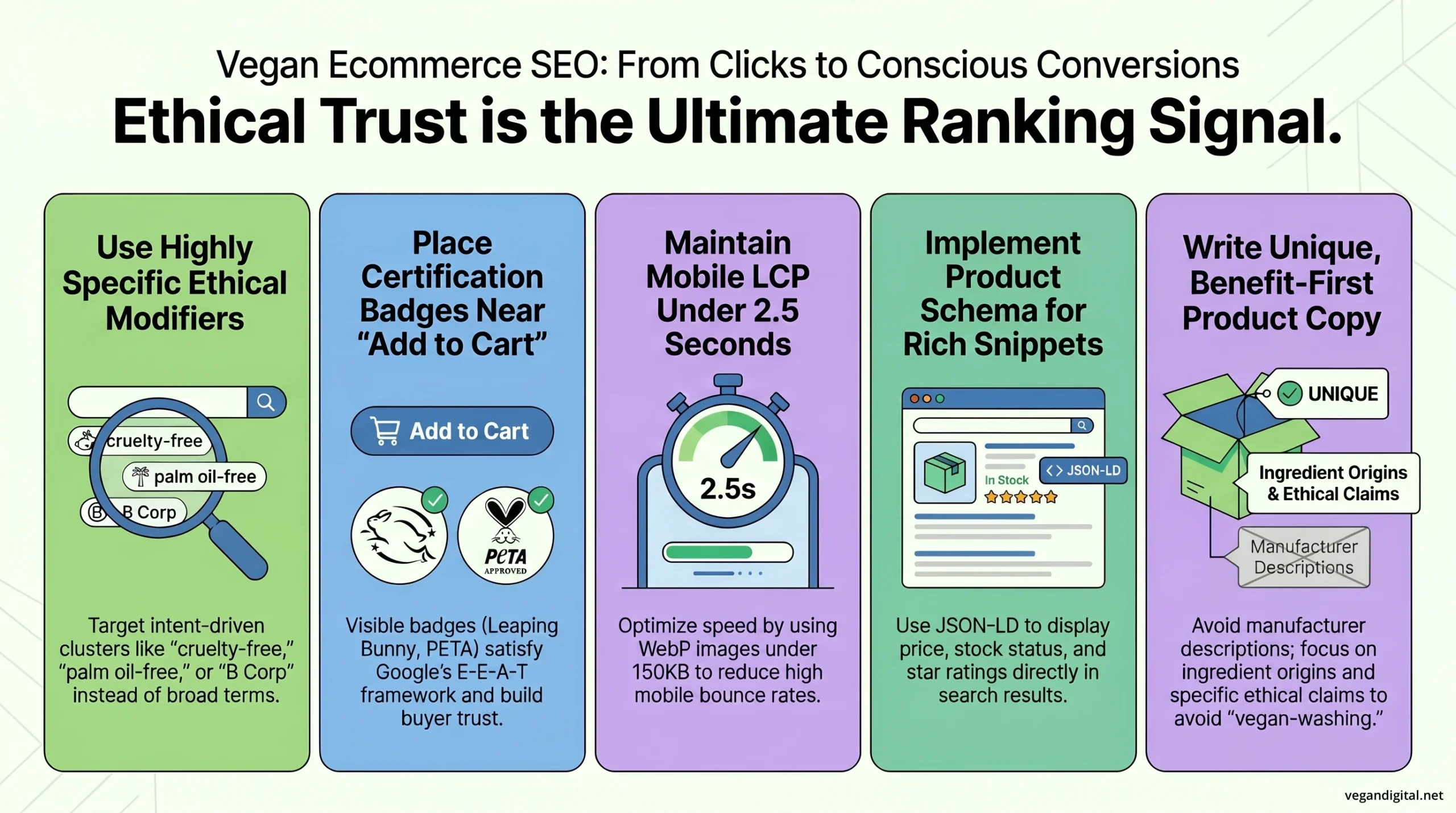
- Ethical modifiers: “cruelty-free,” “Leaping Bunny certified,” “not tested on animals”
- Exclusion modifiers: “soy-free,” “palm oil-free,” “nut-free vegan protein”
- Certification modifiers: “PETA approved,” “certified vegan,” “B Corp”
What most brands miss: Terms like “vegan recipes” or “vegan food near me” attract readers, not buyers. Targeting them wastes resources and muddies your site’s topical focus. Stick strictly to commercial and transactional queries.
Map keywords to page types before writing a single word:
| Search Style | Search Length | Example | Website Page |
| Vegan Focus | Short | vegan makeup | Main Shop Page (All Makeup) |
| Vegan Focus | Medium | vegan face wash | Section Page (Face Care) |
| Vegan Focus | Long | vegan dry skin face wash | Single Product Item |
| Animal Friendly | Short | cruelty free soap | Main Shop Page (All Soap) |
| Animal Friendly | Medium | cruelty free hair soap | Section Page (Shampoo) |
| Animal Friendly | Long | cruelty free tea tree shampoo | Single Product Item |
| Free From (Allergies) | Short | nut free snacks | Main Shop Page (All Snacks) |
| Free From (Allergies) | Medium | nut free cookies | Section Page (Cookies) |
| Free From (Allergies) | Long | nut free chocolate chip cookies | Single Product Item |
| Official Badges | Short | certified vegan shoes | Main Shop Page (All Shoes) |
| Official Badges | Medium | certified vegan boots | Section Page (Boots) |
| Official Badges | Long | certified vegan black winter boots | Single Product Item |
How to Optimize Product Pages and Category Pages for SEO
Every page must satisfy Google’s ranking criteria and earn the trust of a buyer who has likely encountered misleading “vegan-washing” before.
Category pages should target broad commercial keywords. On every category page:
- Write an H1 that matches the primary keyword exactly, for example “Vegan Skincare,” not “Our Amazing Skincare Range”
- Add 80 to 150 words of crawlable intro copy above the product grid
- Include an optional 100 to 200 word outro below the grid covering sourcing standards or certifications
- Never use manufacturer-supplied category descriptions. They are duplicated across dozens of other stores.
Product pages need unique, benefit-focused copy. Follow this structure:
- Open with the single strongest benefit for the conscious consumer, not a feature list
- State specific, verifiable ethical claims: “Certified cruelty-free by Leaping Bunny,” not “eco-friendly”
- Name key ingredients, their origin, and why they are included
- Integrate the long-tail keyword naturally in the H1, the first paragraph, and the meta description
For stores with 50 or more SKUs, rewrite your top 20% of revenue-driving products first. Attempting everything at once leads to inconsistent quality and stalls the project.
The Technical Gap: Schema and Faceted Navigation
Adding Product Schema (JSON-LD) to your product pages enables rich snippets, showing your price, stock status, and star ratings directly in Google search results before anyone clicks. This meaningfully increases click-through rates.
The most important Schema fields to include:
name,description,brandofferscovering price, currency, and availabilityaggregateRatingcovering rating value and review count
Faceted navigation is a duplicate content risk. Every filter combination can generate a unique URL. A category with five filter types and ten options each can produce thousands of near-identical pages.
Fix it with these three actions:
- Apply
rel="canonical"tags on filtered URLs pointing back to the parent category - Noindex filter combinations with no real search demand
- Build dedicated sub-collection pages for high-demand filter combinations like “nut-free vegan protein”
Visible certifications, transparent ingredient sourcing, and integrated customer reviews act as both conversion rate optimizers and E-E-A-T trust signals. Place certification badges near the Add to Cart button, not buried in the footer.
Site Speed: The Mobile Performance Standard
Faster pages rank higher and convert more visitors. Google’s Core Web Vitals are embedded in the ranking algorithm. A store loading in four or more seconds on mobile will be outranked by a comparable store loading in under two. Mobile abandonment rises sharply after three seconds.
Vegan brands rely on high-quality product photography. The fix is not lower image quality. The fix is smarter delivery:
- Convert all product images to WebP format, typically 25 to 35% smaller than JPEG with no visible quality loss
- Compress images to under 150KB before uploading
- Apply lazy loading to all below-the-fold images using the native
loading="lazy"attribute - Activate a CDN to serve assets quickly across North America and Europe
For Shopify stores, remove every app you are not actively using. Each installed app injects JavaScript into your storefront even when idle. For WooCommerce stores, enable full-page caching and use performance-optimized hosting.
Target a mobile LCP (Largest Contentful Paint) under 2.5 seconds as your baseline benchmark.
Your 5-Step Vegan Ecommerce SEO Audit
Step 1: Keyword and Intent Check
- Broad commercial terms are assigned to category pages
- Specific long-tail terms are assigned to individual product pages
- No two pages target the same primary keyword
Step 2: On-Page Optimization
- Every product page has a unique title tag and meta description
- Ethical claims are specific and verifiable, not vague
- All product descriptions are written in-house, not sourced from manufacturers
Step 3: Technical Trust Signals
- Product Schema is live and validated with zero errors in Google’s Rich Results Test
- Canonical tags are applied to all filtered navigation URLs
- Certification badges carry descriptive alt text and sit near the Add to Cart button
Step 4: Performance Audit
- Mobile LCP is under 2.5 seconds
- All product images are in WebP format and under 200KB
- Unused apps or plugins have been removed
Step 5: Internal Link Check
- Category pages link to all relevant sub-categories with descriptive anchor text
- Product pages include two to four related product links
- No orphan pages exist with zero internal links pointing to them