The Ultimate Guide to Web Design for Vegan Businesses in 2026
Generic website templates don’t work for vegan businesses. Your customers aren’t just looking for products or services, they’re looking for alignment with their values. They want to know that the companies they support share their commitment to compassion, sustainability, and ethical practices. A cookie-cutter design template sends the opposite message: “We’re just like everyone else.”
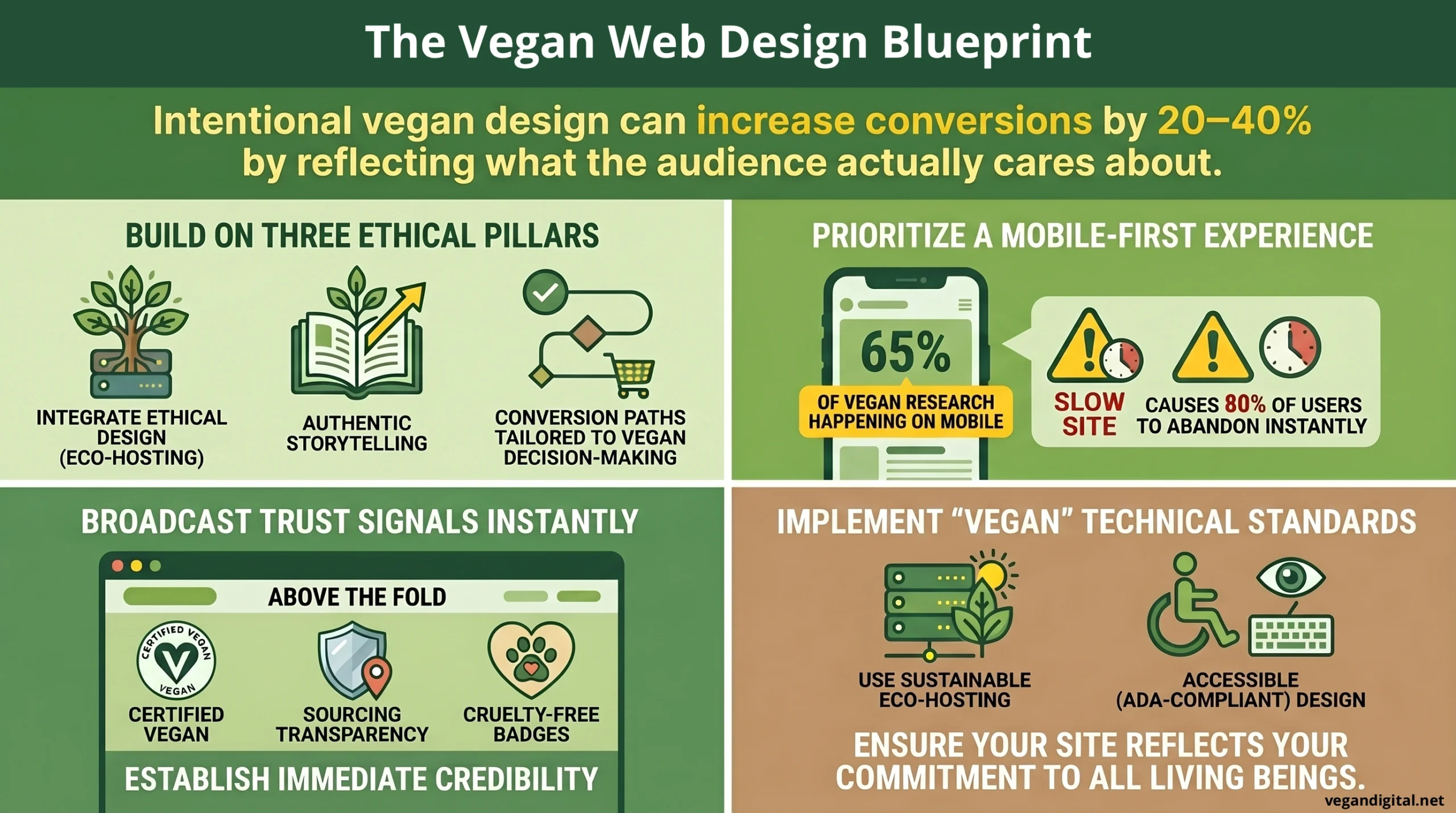
Design matters deeply for vegan brands. Your website is the first real interaction many potential customers have with your business. It’s where they decide whether to trust you, whether your values are authentic, and whether they should spend their money with you. Intentional design can increase conversions by 20-40%, but only if it reflects what your vegan audience actually cares about.
This guide covers the complete vegan web design guide strategies used by top-performing vegan businesses in 2026. You’ll learn exactly how to design a website that builds trust, tells your authentic story, and converts visitors into loyal customers.
What is Vegan Web Design?
Vegan web design is the practice of creating websites specifically optimized for vegan businesses, where design aesthetics, functionality, and messaging all align with vegan values and ethical principles.
The distinction matters. It’s not just using green colors on your site. True vegan web design is built on three core pillars:
- Ethical design practices that consider environmental impact (like eco-friendly hosting) and accessibility for all users
- Authentic brand storytelling that transparently communicates your mission, sourcing, and values
- Conversion optimization designed specifically for how vegan consumers make purchasing decisions
How It Differs from Standard Web Design
Standard web design focuses on aesthetics and basic functionality. Vegan web design goes further. Your audience needs to see:
- Values transparency throughout your site, not hidden in a small footer statement
- Storytelling requirements that go beyond product descriptions to explain the “why” behind your business
- Trust-building elements like certifications, sourcing information, and ethical practices documentation
- Addressing misconceptions that are common in vegan spaces, like pricing concerns or product quality questions
Your vegan customers vet businesses differently. They’ll check your supply chain, look for cruelty-free certifications, and want to know that your website itself is built ethically. A standard designer won’t understand these nuances.
Why Vegan Business Owners Need Strategic Web Design
The Trust Factor
Vegan consumers actively research the businesses they support. Your website design signals trustworthiness before anyone reads a single word.
- Design consistency builds credibility: When your colors, fonts, and visual style match across every page, customers see a professional, established business
- Visual hierarchy shows you’ve thought carefully about what matters: What’s above the fold? What’s emphasized? Clear visual priorities build confidence
- Professional imagery matters more than you think: Stock photos of unhappy models feel inauthentic to vegan audiences, who can spot corporate greenwashing instantly
- Transparent layouts make information easy to find: If sourcing details, certifications, or sustainability practices require digging, customers assume you’re hiding something
Conversion Impact
A well-designed vegan business website doesn’t just look nice. It makes money.
- Intentional design increases customer lifetime value by creating multiple touchpoints for engagement and repeat purchases
- Mobile optimization directly impacts conversion rates: Over 65% of vegan product research happens on mobile devices, and a slow, poorly-designed mobile experience will send customers to your competitors
- Clear conversion paths reduce friction: From “exploring your site” to “checking out” should be obvious and effortless
- Trust signals placed strategically (certifications, testimonials, guarantees) can reduce cart abandonment by 10-15%

Vegan businesses that invest in strategic design see 2-3x better conversion rates than those using generic templates.
Establishing a Powerful Vegan Brand Identity on Your Website
Understanding Ethical Branding for Your Vegan Business
Ethical branding means transparently communicating who you are, what you stand for, and exactly how you deliver value while staying true to vegan principles.
The key principles are straightforward:
- Transparency: Don’t hide where your ingredients come from or how your products are made
- Authenticity: Show the real story behind your brand, including the founders’ journey and motivation
- Sustainability: Communicate your environmental impact and specific steps you’re taking to reduce it
- Accountability: Be willing to publicly address mistakes and show how you’ve improved
Your brand identity translates directly to visual design. A brand that values sustainability shouldn’t use garish, cheap-looking design. A brand built on transparency shouldn’t hide important information behind dark colors or unclear navigation.
Color Psychology & Design Aesthetics for Vegan Brands
Colors communicate meaning. Your vegan audience expects specific color choices and will notice if you get them wrong.
- Green and earth tones work well because they signal nature, health, and sustainability, but avoid overusing green (it feels clichéd)
- Warm neutrals like beige, tan, and cream convey approachability and wholesomeness
- Vibrant colors work if they’re used strategically: Bright oranges or reds can grab attention for CTAs, but only if the rest of your design is balanced
- Typography matters: Serif fonts can feel traditional and trustworthy, while sans-serif fonts feel modern and clean. Choose based on your brand personality
- Visual imagery should show real people, real farms, real production, and real diversity. Stock photos of perfect people feel inauthentic to vegan consumers
Minimalist design trends toward more credibility for vegan brands. White space, clear typography, and intentional visual elements communicate sophistication and values alignment.
Vegan Branding for Websites: Best Practices
Your visual brand must be consistent everywhere.
- Logo and brand consistency: Your logo should appear the same across your website, social media, packaging, and emails
- Voice and tone guidelines: If your brand voice is warm and conversational, your website copy should feel that way too. If it’s professional and scientific, match that tone consistently
- Navigation and layout: Organize your site structure to reflect what matters most to your audience
- Color palette: Limit yourself to 3-5 colors (including neutrals) so your site feels cohesive
- Imagery style: Decide if you’ll use photography, illustrations, or both, then stick with that choice throughout
A cohesive visual language builds recognition. When customers see your site, they should immediately know it’s authentically you.
Mobile UX: Designing for Vegan Consumers On-the-Go
Why Mobile-First Design Matters
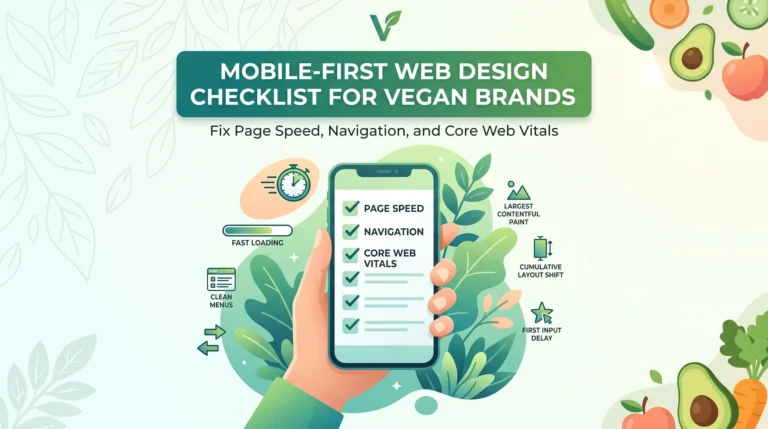
Mobile-first design means building your website for small screens first, then expanding to larger devices, because most of your vegan customers browse on their phones.
The numbers are clear:
- Over 65% of vegan product research happens on mobile devices
- 80% of vegan consumers who encounter slow or poorly-designed mobile sites abandon them immediately
- Google’s ranking algorithm prioritizes mobile-friendly sites, so non-mobile-optimized sites lose visibility
- Core Web Vitals (Google’s measurement of loading speed, interactivity, and visual stability) directly impact your search rankings
Mobile users behave differently. They’re usually researching quickly, comparing prices, or checking if your business is near them. A website built for desktop won’t serve these needs.

Essential Mobile UX Elements
- Simplified navigation: Collapsible menus and clear hierarchies so users find what they need in 2-3 taps
- Fast-loading images: Compressed images under 100KB where possible, so pages load in under 3 seconds
- One-click checkout: Saved payment information, guest checkout options, and autofill features reduce friction
- Thumb-friendly CTAs: Buttons placed at the bottom of the screen where thumbs naturally rest
- Readable text: Font sizes no smaller than 16px, sufficient contrast ratios, and plenty of white space
- Touchable elements: All clickable areas should be at least 48×48 pixels to prevent accidental clicks
Testing and Optimizing Mobile Performance
Test before you launch and test regularly after.
- Google Mobile-Friendly Test is free and shows exactly what needs improvement
- Google PageSpeed Insights measures real user experience metrics and gives specific recommendations
- A/B testing for mobile conversions: Test button placement, colors, copy length, and checkout process to see what converts best
- Monitor mobile performance monthly because Google updates its ranking factors regularly
How to Design a Vegan Business Website: Core Components
Homepage Strategy
Your homepage has about 3 seconds to communicate value and build trust.
- Hero section with clear value proposition: In under 10 words, tell visitors why they should care about your business. “Ethically-sourced vegan skincare that actually works” beats “Welcome to our skincare brand”
- Trust signals above the fold: Certifications, customer testimonials, or press mentions should be visible before anyone scrolls
- Navigation structure for discoverability: Organize by customer need (Shop, Learn, About, Contact) rather than company structure
Storytelling Pages (About, Mission, Values)
This is where you differentiate from competitors.
- Your vegan story matters: Customers want to know why you started this business. Was there a personal moment? A health realization? Environmental awakening?
- Structure narrative for conversions: Use the “Before, After, Bridge” model: “I used to feel guilty buying beauty products” (Before), “Then I discovered cruelty-free alternatives” (After), “Now I can look good without compromising my values, and you can too” (Bridge)
- Building emotional connection: Use real language, admit challenges you faced, and show personality
- Sustainability and ethical sourcing transparency: Link to detailed information about where every ingredient comes from
Product Pages That Convert
Product pages are where browsers become buyers.
- Product photography and lifestyle imagery: Show the product being used in real contexts, not just white backgrounds
- Benefit-focused copy with value alignment: Don’t just describe features (“This serum contains hyaluronic acid”), explain benefits aligned with values (“This serum hydrates skin without any animal-derived ingredients”)
- Customer reviews and social proof: Real testimonials from real customers beat marketing copy every time
- Clear pricing and shipping transparency: Include shipping costs upfront, return policies, and any guarantees
Building Trust on Every Page
Trust isn’t built on a single element. It’s built through consistent signals.
- Certifications and badges: Vegan, cruelty-free, organic, fair-trade labels matter to your audience
- Customer testimonials and case studies: Show real results from real people
- Money-back guarantees: Remove purchase risk by promising refunds
- Transparency about sourcing and production: Link to detailed information or create a “Transparency” page
Contact & Community Sections
Don’t make customers hunt for ways to reach you.
- Multiple contact options: Email, phone, live chat, contact form, social media links
- Community engagement: Newsletter signup, social media links, and community features like user-generated content or forums
- FAQ addressing vegan-specific concerns: “Are your materials ethically sourced?” “How is this different from similar products?” “Is this product certified vegan?”
Conversion Funnels Designed for Vegan Audiences
Awareness Stage
Potential customers don’t know your business exists yet.
- Blog content addressing common vegan questions: Write posts like “10 myths about vegan skincare,” “How to find cruelty-free brands,” or “Why vegan businesses cost more”
- Educational landing pages: Create pages targeting specific questions your audience searches for
Consideration Stage
Customers know you exist but aren’t ready to buy.
- Product comparison guides: Help them understand why your product is worth the investment
- Value proposition clarity: Repeatedly communicate what makes your business different
- Overcoming price objections: Explain the value proposition, show long-term savings, or offer payment plans
Decision & Checkout
They’re ready to buy, but friction can stop them.
- Friction-free checkout process: Minimum form fields, guest checkout option, one-page checkout
- Trust reassurance: Security badges, testimonials, guarantees visible during checkout
- Exit-intent offers: If they’re leaving without buying, offer a discount or free shipping
Post-Purchase Engagement
The sale isn’t the end, it’s the beginning.
- Welcome emails with brand storytelling: Reinforce their decision to buy from you
- Community building opportunities: Invite them to a Facebook group, loyalty program, or customer community
- Loyalty programs aligned with vegan values: Reward repeat customers, offer referral incentives, or donate to vegan nonprofits based on purchases
Technical Foundations: Site Speed, SEO-Friendly Web Design, and Eco Hosting
Site Speed Optimization
Site speed is a ranking factor and a conversion factor, meaning a slow website loses customers to competitors and loses Google visibility simultaneously.
Optimize for speed with these strategies:
- Image compression: Use tools like TinyPNG or ImageOptim to reduce file sizes without losing quality
- Lazy loading: Images load only when users scroll to them, not when the page first loads
- Minifying CSS and JavaScript: Remove unnecessary characters to reduce file sizes
- Content Delivery Network (CDN): Serve your site from servers geographically closer to your visitors
- Caching: Tell browsers to store certain files locally so repeat visitors don’t re-download everything
- Performance target: Aim to load your entire homepage in 3 seconds or less on a standard 4G connection
SEO-Friendly Web Design for Vegan Businesses
SEO-friendly web design for vegan businesses means structuring your site so search engines understand your content and show it to people searching for vegan products or services.
Core elements include:
- On-page SEO essentials: Clear H1 tags (one per page), descriptive meta descriptions (under 160 characters), alt text for every image
- Schema markup: Use structured data to tell Google what type of business you are, what products you offer, and where customers can find you
- Internal linking strategy: Link between related pages to help Google understand your site structure and keep visitors engaged
- Keywords naturally integrated: Include your target keywords (like “vegan skincare” or “cruelty-free cosmetics”) in headings, introductions, and naturally throughout your content
Don’t force keywords. Write for humans first, search engines second.
Sustainable Hosting Solutions
Eco hosting means your website runs on renewable energy, which aligns with vegan brand values and reduces your environmental impact.
Why it matters:
- Data centers use massive amounts of electricity, and traditional hosting often relies on fossil fuels
- Eco-friendly hosts use renewable energy, carbon offsets, or both
- Your vegan customers will respect this commitment
- Many eco hosts also practice ethical labor practices
Popular eco-friendly hosting providers include GreenGeeks, A2 Hosting (carbon neutral), and SiteGround (renewable energy partner). Check their sustainability practices before signing up. See our Green Web Hosting Statistics for industry trends and insights.
Accessibility: Inclusive Web Design for All
Why Accessibility Matters
Accessible web design means building websites that work for everyone, including people with disabilities, who make up about 15% of the population.
Three important reasons:
- Legal requirements: The Americans with Disabilities Act (ADA) applies to websites. Non-compliance can result in lawsuits
- Ethical alignment: Vegan principles extend to inclusivity. If you claim to care about all living beings, your website should be usable by everyone
- SEO benefits: Many accessibility practices overlap with SEO best practices (like alt text for images and clear heading structure)
Key Accessibility Features
- Color contrast ratios: Text should have at least a 4.5:1 contrast ratio against its background (dark text on light background, for example)
- Keyboard navigation: Every function accessible via mouse should also be accessible via keyboard (Tab, Enter, arrow keys)
- Alt text for images: Describe what’s in the image in 125 characters or less
- Readable fonts and spacing: Use fonts that are easy to read (sans-serif works well), avoid text-only images, and use plenty of white space
- Screen reader optimization: Structure your HTML properly so screen readers can navigate your site logically
Testing for Accessibility
Don’t guess. Test.
- Automated tools: WAVE, Axe, and Lighthouse (built into Chrome) automatically check for common accessibility issues
- Manual testing: Tab through your site using only your keyboard, zoom in to 200% and try navigating, or use a screen reader yourself
- Real user testing: Ask people with disabilities to test your site and give feedback
Vegan Website Design Best Practices: Actionable Checklist
Use this checklist to audit your current website or plan your next redesign.
Pre-Design Phase
- Define your brand identity and core values
- Research your target vegan audience and competitors
- Create a content strategy aligned with keyword targets
- Map customer journey and conversion goals
Design & UX Phase
- Choose eco-friendly hosting provider
- Select mobile-responsive website builder or platform
- Design consistent brand color palette and typography
- Create intuitive navigation structure
- Optimize images for fast loading (compressed under 100KB where possible)
- Implement trust signals (certifications, testimonials) above the fold
- Design clear, single-focus CTAs
Content & Storytelling Phase
- Write compelling About page with vegan origin story
- Create product pages with lifestyle photography and benefit-driven copy
- Develop FAQ addressing vegan-specific concerns (sourcing, certifications, comparisons)
- Add customer testimonials and case studies
- Include sustainability and ethical practices transparency
Technical Optimization Phase
- Ensure mobile responsiveness across all devices
- Set up SSL certificate (HTTPS)
- Optimize page titles and meta descriptions (include primary keyword)
- Add alt text to all images
- Implement schema markup (Product, Organization, LocalBusiness)
- Test page speed with Google PageSpeed Insights
- Set up Core Web Vitals monitoring
- Enable GZIP compression
- Minimize CSS and JavaScript files
Accessibility Audit Phase
- Test color contrast ratios (min 4.5:1 for text)
- Verify keyboard navigation works
- Test with screen reader
- Check heading hierarchy (H1, H2, H3 properly structured)
- Ensure forms are labeled and accessible
Conversion Optimization Phase
- Design conversion funnel (awareness, consideration, decision)
- Create friction-free checkout process
- A/B test CTAs and page layouts
- Set up email capture for newsletter and loyalty programs
- Implement exit-intent offers
- Add live chat or customer support option
Post-Launch Phase
- Set up Google Analytics 4 and conversion tracking
- Monitor Core Web Vitals monthly
- Collect and respond to customer feedback
- Update content regularly (blog, testimonials)
- Audit and improve site speed quarterly
- Review SEO performance and adjust keywords
Conclusion
Vegan web design isn’t a trend. It’s a business necessity. Your website is where you prove your values are real, where you build trust, and where you convert passionate customers into loyal advocates. Intentional design directly impacts your bottom line.
The checklist above gives you everything you need to audit your current website or build something new. But implementation takes time, strategy, and often expert guidance.
If you want to accelerate your results or need a partner who understands both vegan values and conversion optimization, consider a vegan web design agency that specializes in helping ethical brands succeed. A strategic partner can save you months of trial and error and help you build a website that truly represents your business.
Start today with one item from the checklist. Then tackle another. Momentum matters more than perfection.